
Independent scientific advisory for complex biological measurement and interpretation
Clarify what your evidence supports before it shapes a consequential decision.
Baseline Bio Advisory helps life-science teams determine what complex biological measurements legitimately support—and what should be strengthened before those measurements inform development decisions, workflow transfer, product claims, reports, or external communication.
Deep biological expertise
Mitochondrial and metabolic measurement, cellular bioenergetics, functional analysis, and toxicity assessment
Broader advisory scope
Complex biological measurement chains spanning assay design, technology, software, interpretation, validation, transfer, and decisions
More interpretable evidence. More reproducible and transferable workflows. More defensible decisions.
Where Baseline Adds the Most Value
Baseline is most relevant when complex biological evidence must support a consequential next use while material questions remain about the model, workflow, measurement system, software outputs, validation, transfer, or interpretation. Selective work also includes CROs, specialty service providers, and scientific-content teams.
Promising proof-of-concept data are moving toward financing, partnership, product development, platform claims, or external transfer.
Baseline helps identify where early choices in models, assays, workflows, software outputs, validation, and interpretation may create downstream constraints before they become difficult or expensive to change.

University spinouts & early-stage biotech
An internally successful assay, workflow, reagent, consumable, software output, or application must be qualified, transferred, supported, or used to substantiate product claims.
Baseline helps clarify what controls performance, what broader use requires, and where transfer or interpretation may become unreliable.

Platform, tools, & measurement companies
Complex biological evidence is influencing mechanism, toxicity, biomarker, translational, or go/no-go decisions.
Baseline helps trace where uncertainty enters across models, workflows, measurement systems, software outputs, and interpretation, and determine whether the resulting evidence is sufficiently reliable and relevant for the intended use.

R&D, translational, preclinical, & clinical teams
Two Paths Into Complex Measurement Questions
Baseline can support either a focused mitochondrial or metabolic need or a broader biological measurement-system challenge, depending on where the scientific question begins. The subject matter may differ, but the core question remains the same: what does the measurement legitimately support, and what should be strengthened before it informs the next decision?
Mitochondrial and metabolic measurement guidance
For teams facing complex mitochondrial or metabolic questions where biological context, measurement quality, and interpretation must align.
Live-cell assay and experimental design
Biological model, sample, and assay-condition selection
Mitochondrial-function and bioenergetic interpretation
ATP production and real-time ATP-rate measurement
Substrate oxidation, fuel use, and metabolic flexibility
Mitochondrial toxicity assessment and interpretation
Advanced workflow optimization, troubleshooting, and transfer
Customized training, workshops, and on-site laboratory support

Broader biological measurement-system advisory
For teams working with complex biological evidence that crosses technical or functional boundaries and must support reliable downstream use.
Measurement-chain review and system-level assessment
Assay, workflow, and technology integration
Validation strategy and transfer-readiness planning
Software outputs, normalization, and data transformation
Measured, calculated, normalized, and inferred evidence
Interpretation boundaries and evidentiary scope
Scientific, product, and performance claim support
Decision support, external readiness, and communication


Embedded technical constraints

Development direction & resource allocation
Workflow performance & transfer

Claims and external confidence
When Scientific Uncertainty Becomes Organizational Risk
Scientific ambiguity becomes organizational exposure when it begins to influence commitments that are costly or difficult to reverse. The objective is not to eliminate all uncertainty. It is to identify which uncertainties are material before they affect consequential use.
Weak model relevance or overextended interpretation can direct capital, personnel, and development effort toward conclusions or pathways that are not adequately supported.
Choices made during proof of concept may later require costly rework when the system is scaled, transferred, scrutinized, or used to support broader claims.
Uncharacterized variables can emerge later as user-, sample-, instrument-, reagent-lot-, software-, or site-dependent performance, complicating qualification, validation, & transfer.
Evidence-to-claim misalignment can reduce investor, partner, customer, reviewer, regulatory, or internal confidence—even when the underlying technology or biology remains promising.
From Scientific Question to a Defined Next Step
The source of uncertainty is not always where the problem first appears. Baseline examines how uncertainty enters, propagates, or constrains the intended use of the evidence. An integrated view is particularly useful when the relevant evidence crosses biological, assay, instrumentation, software, product, interpretation, and decision boundaries that no single function fully owns.
The Measurement Chain
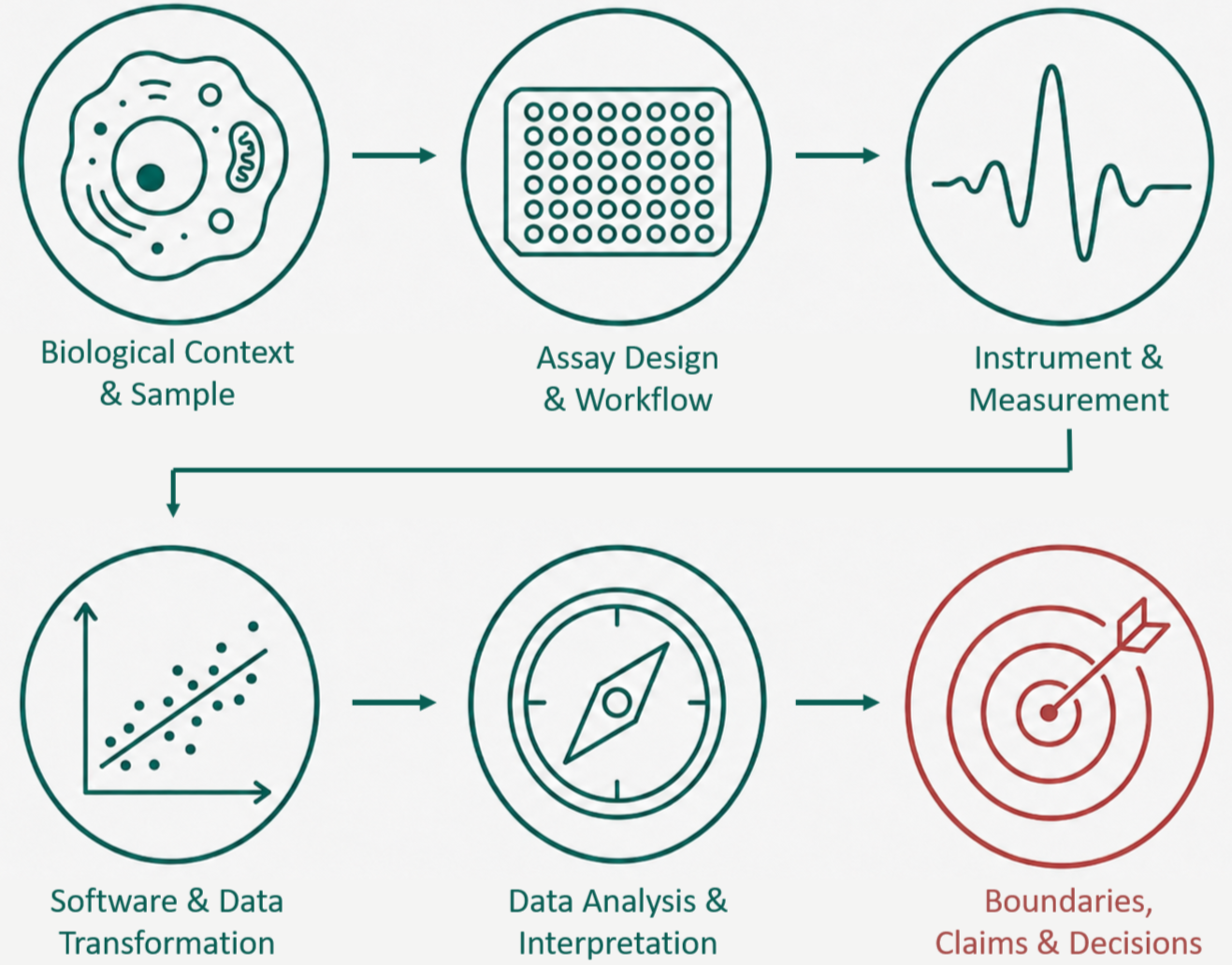
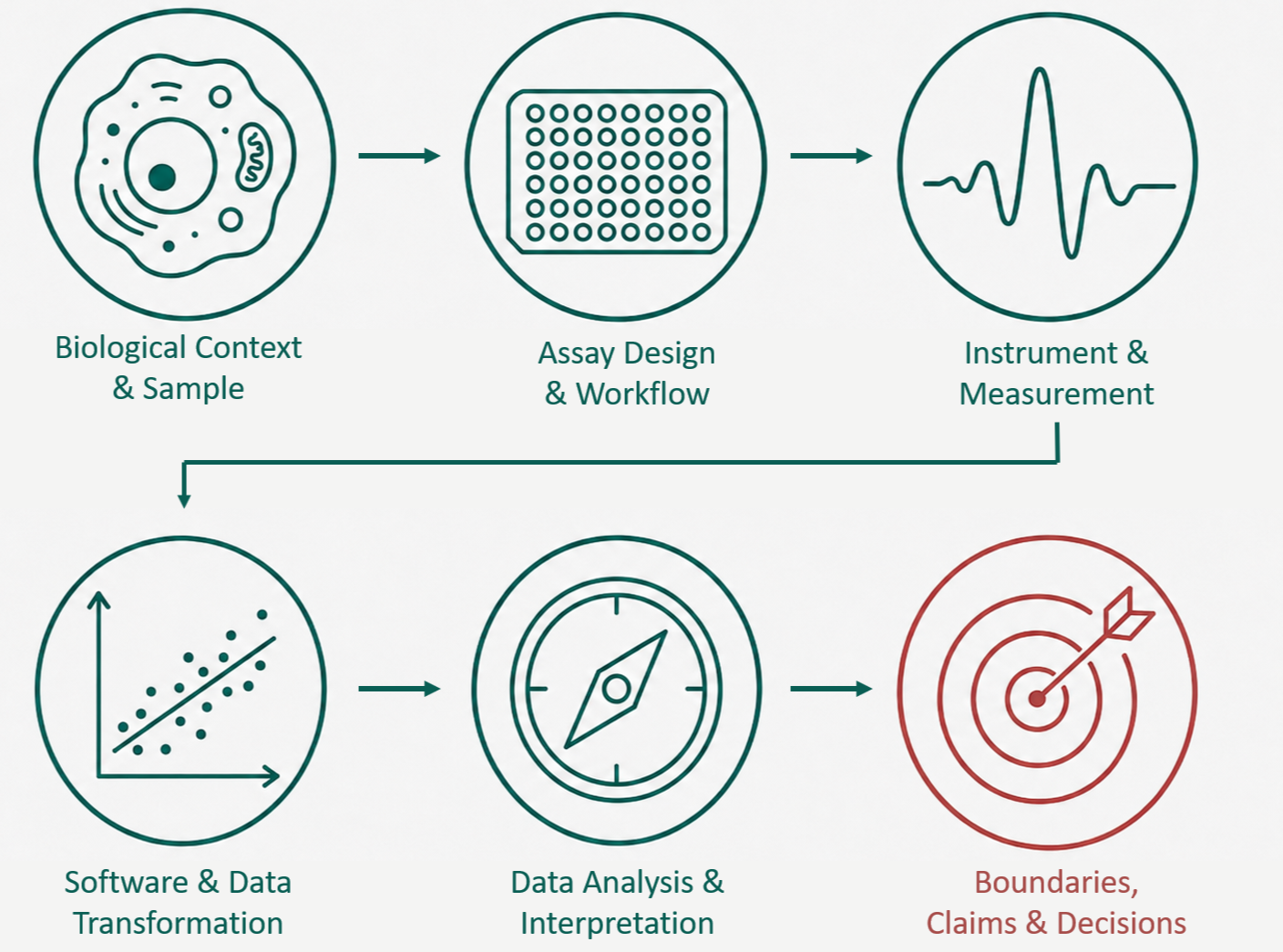
Biological context, workflow, measurement technology, software, and interpretation are interconnected; each can affect what the resulting evidence legitimately supports.
Baseline converts an unresolved question into a structured evaluation, evidence-aligned interpretation, and defined next step.
Question → Understand → Strengthen



Question: What must the measurement, workflow, evidence, or claim support?
Understand: Where is confidence reduced, where might limitations propagate as use expands, and what signals would reveal a material problem before the next decision?
Strengthen: What should be corrected, qualified, validated, transferred, measured orthogonally, or communicated differently?
Choose the Right Starting Point
Baseline engagements typically begin in one of three ways. Mitochondrial and metabolic support can enter through any of these pathways—from a focused assay or interpretation question to customized training, on-site support, or ongoing advisory work.
Defined Advisory Build

Structured development or refinement of a workflow, interpretation framework, transfer plan, validation structure, or evidence package.
Focused Scientific Diagnostic

Independent review of a defined data, workflow, interpretation, transfer, or claim question.
Ongoing Scientific Advisory

Periodic senior scientific input across an evolving platform, program, product, or service line.
Mitochondrial measurement & capability building

Focused consultation, assay and interpretation support, customized teaching, hands-on workshops, on-site laboratory review, workflow transfer, and continued advisory follow-up.


Outputs Built Around the Next Decision
Baseline engagements begin with a defined scientific or measurement question and produce focused outputs that support a specific decision, transfer, claim, workflow, or next measurement.
Decision map
Clarifies what is supported, uncertain, overextended, or not yet ready for consequential use.
Transfer-readiness plan
Identifies critical variables, controls, acceptance criteria, training gaps, SOP limitations, and transfer requirements.
Measurement-risk and dependency map
Shows where current choices may constrain validation, transfer, claims, or future applications—and distinguishes what requires action and what can be monitored.
Targeted evidence plan
Defines the controls, qualification work, repeat studies, orthogonal measurements, or interpretation refinements most likely to strengthen the next step.
Where Biology, Measurement, and Development Meet
Baseline combines deep biological expertise, full measurement-system experience, and direct senior scientific judgment to help teams resolve complex questions that do not fit neatly within one function or discipline. The transferable proof is repeated experience helping complex biology and emerging technology become usable, interpretable, transferable, and scientifically defensible.
Deep mitochondrial & metabolic expertise
Mitochondrial and metabolic measurements are highly informative but context-dependent. Deep experience in bioenergetics, substrate oxidation, metabolic flexibility, live-cell analysis, and mitochondrial toxicity helps distinguish meaningful biological responses from workflow or measurement effects—and define what the evidence can support.
Full measurement-system perspective
Complex biological evidence depends on more than the assay itself. Experience across models, assay architecture, instruments, software outputs, validation, normalization, transfer, interpretation, training, and adoption helps identify where uncertainty enters and what must be strengthened before broader use or consequential decisions.
Proven development experience


George W. Rogers, Ph.D. brings extensive experience developing biological measurement systems from research through commercialization. His work spans assay and workflow development, software-supported interpretation, validation, publications, training, technology transfer, product requirements, claims, and customer adoption.
Published Perspective
From mitochondrial signal to discovery decision: a reserve–demand framework for translational risk assessment
George W. Rogers & Yvonne Will | Expert Opinion on Drug Discovery | 2026
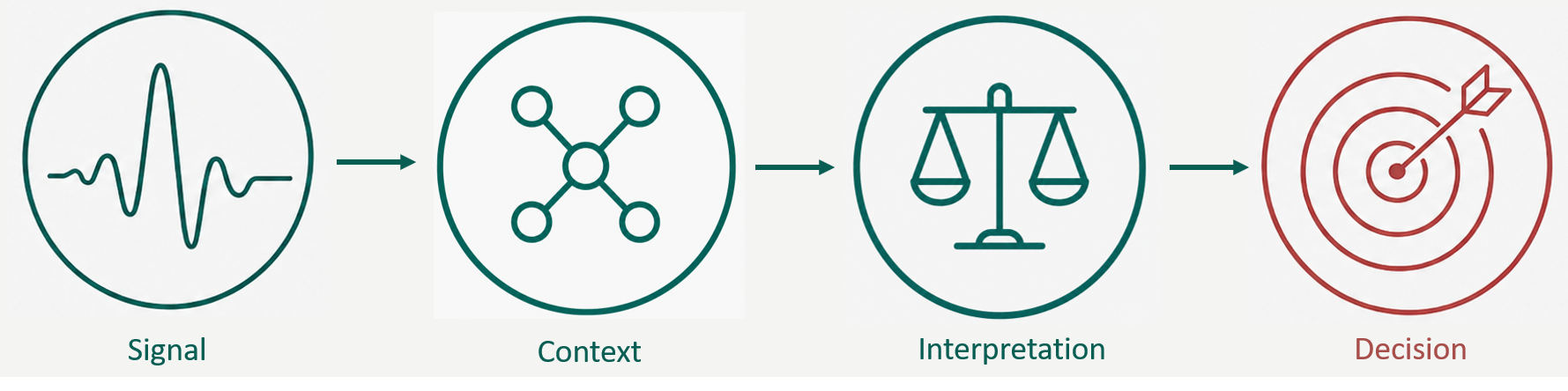
Published in Expert Opinion on Drug Discovery, the paper examines how mitochondrial signals can be translated into discovery decisions using reserve–demand biology, exposure relevance, temporal progression, and translational concordance. The framework links these evidence patterns to four practical actions: Stop, Optimize, Monitor, or Acceptable Risk.
Its emphasis on biological context, interpretation boundaries, and intended decision use reflects the same scientific perspective that informs Baseline’s approach to complex biological measurement.
Start with the Scientific Question
A focused initial discussion can determine whether Baseline is relevant and whether the appropriate starting point is an independent review, a defined advisory build, or selective ongoing scientific support.
What must the evidence support?
Development decision, product claim, workflow transfer, program direction, report, milestone, or external communication.

Where is the evidentiary constraint?
Biological context, assay or workflow, measurement-system behavior, software-derived output, validation, interpretation, transfer, claims, or adoption.
What level of support may be appropriate?
Independent review, action plan, refinement, implementation support, or ongoing advisory input.
Have a measurement or interpretation question?
Start with a focused discussion to determine whether Baseline can help and what level of support may be appropriate.
Please provide only a brief, non-confidential description. Do not submit proprietary, patient-identifiable, or other sensitive information through this form. Submission of this form does not establish an advisory relationship.