
We’ve all experienced this: a problem emerges somewhere between the biology, the measurement, and the interpretation.
A study begins with a reasonable question and a sound plan.
Then a result is difficult to reproduce, a workflow behaves differently than expected, a technical limitation emerges, or the evidence no longer supports quite what everyone thought it did.
What follows can consume far more than another experiment. It can mean weeks of troubleshooting, additional samples and reagents, engineering or software work, repeated discussions, delayed decisions, and lost momentum.
I have encountered versions of this throughout my career—sometimes while solving the problem, and sometimes while helping create it.
That experience is a major reason why Baseline Bio Advisory was created.
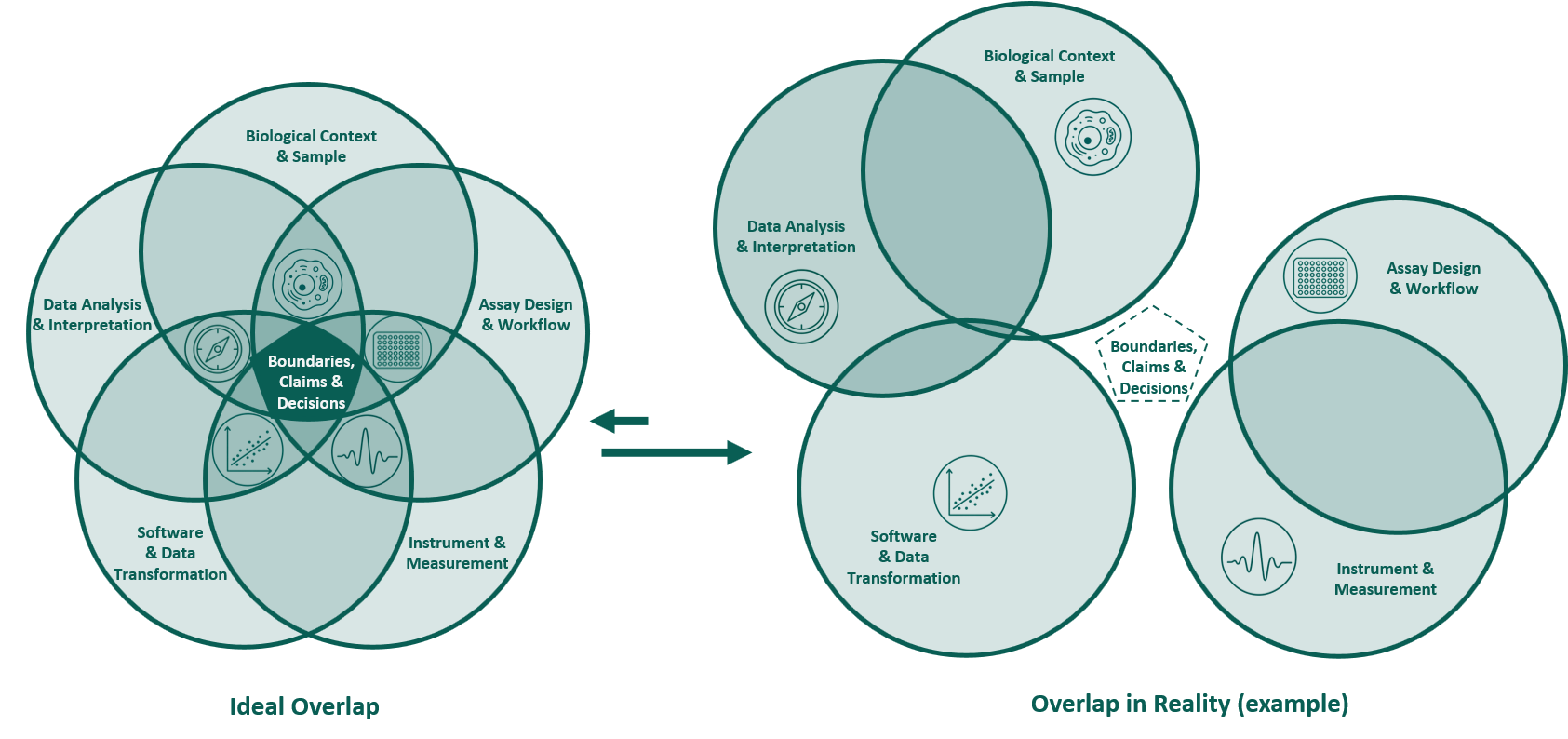
Five elements of the measurement system are ideally aligned around a common evidentiary center (left). In practice, biological, technical, analytical, or interpretive variables often drift out of alignment, reducing confidence in what the evidence can support (right). Baseline helps identify and realign the variables that matter most so evidence boundaries, claims, and decisions remain defensible.
Experience should shorten the learning curve
Science will always involve uncertainty, failed hypotheses, and experiments that do not work. That is part of discovery.
But not all scientific waste is unavoidable.
Teams should not have to rediscover every limitation, repeat every troubleshooting path, or learn every lesson independently. Experience is most valuable when it helps recognize a familiar pattern earlier, identify the assumption that matters, and avoid spending unnecessary effort on the wrong problem.
That is one of the things Baseline provides: the benefit of lessons already learned, applied to a new scientific question.
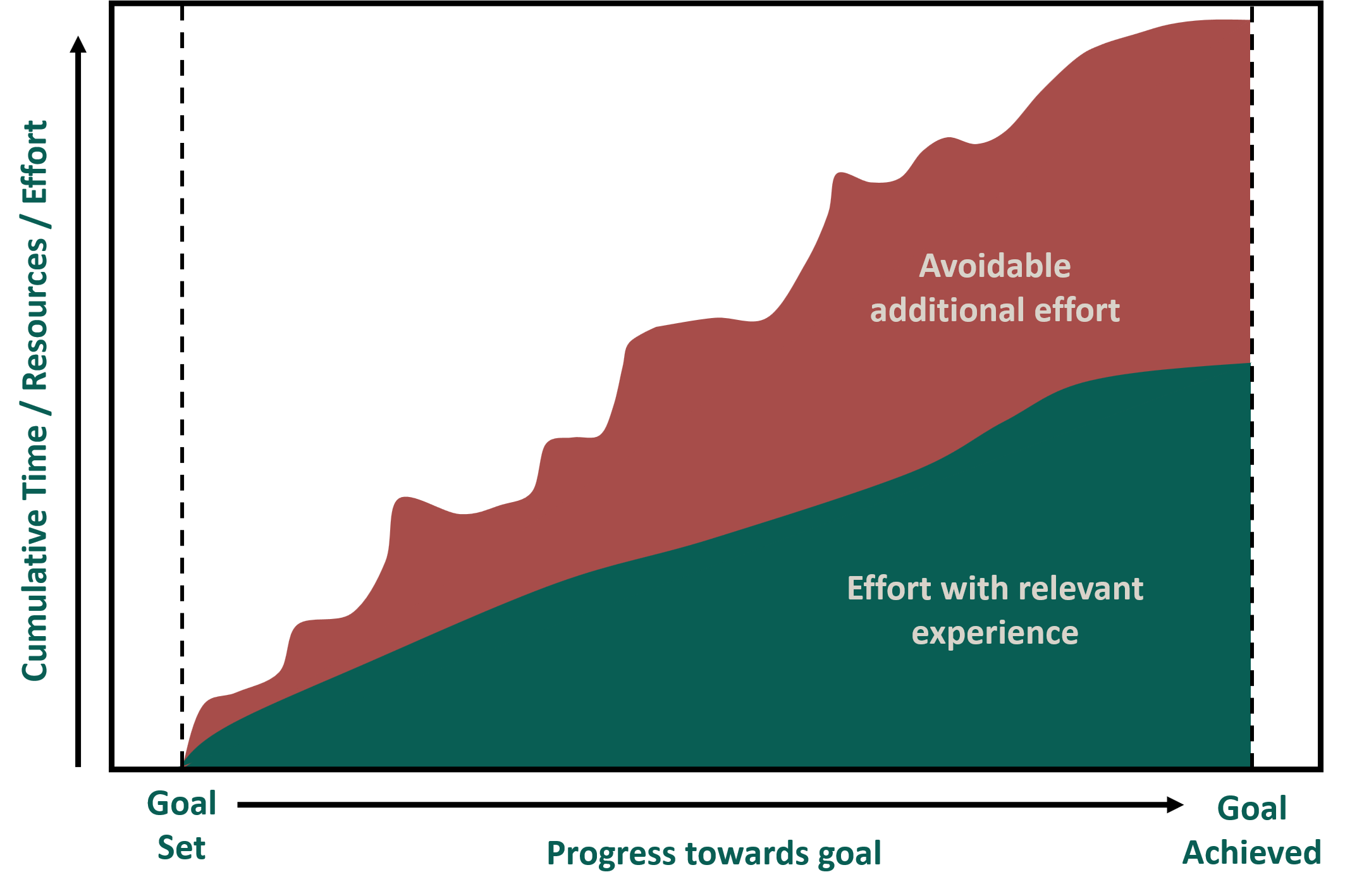
Experience cannot eliminate scientific uncertainty, but it can reduce avoidable effort and help teams reach the same goal more deliberately. The green area represents the cumulative time, effort, and resources required with experienced guidance; the red area represents additional effort from detours, troubleshooting, and rework. Together, green + red illustrate the greater total investment that may be required to reach the same goal without that experience.
Make scientific effort count
The objective is not simply to do less. It is to use experiments, samples, technology, people, and time where they can actually strengthen the evidence.
That requires doing some of the harder work up front: looking carefully at what is being measured, understanding the dependencies in the workflow, challenging assumptions, and distinguishing what the data demonstrate from what is being inferred.
The goal is not perfect efficiency or the elimination of scientific uncertainty. It is to improve the odds that the work being done actually moves the question forward.
Baseline Bio Advisory’s mission
To help life-science teams make better use of scientific effort—recognizing critical problems earlier, reducing avoidable rework, and bringing biology, measurement, technology, and interpretation into better alignment.
Learn deeply. Explain clearly.
I have always enjoyed learning difficult science and then finding a way to make it understandable to someone else.
That usually means going back to first principles, breaking a complex problem into manageable pieces, understanding the audience, and finding the language or analogy that makes the underlying idea clear.
That skill became especially valuable when scientific problems crossed functional boundaries. Scientists, engineers, software developers, quality teams, product groups, and business leaders may all need to understand the same issue—but they do not necessarily approach it from the same starting point.
One of the most satisfying parts of this work is the moment when the problem becomes clear to everyone involved: what is happening, why it matters, and what needs to happen next.
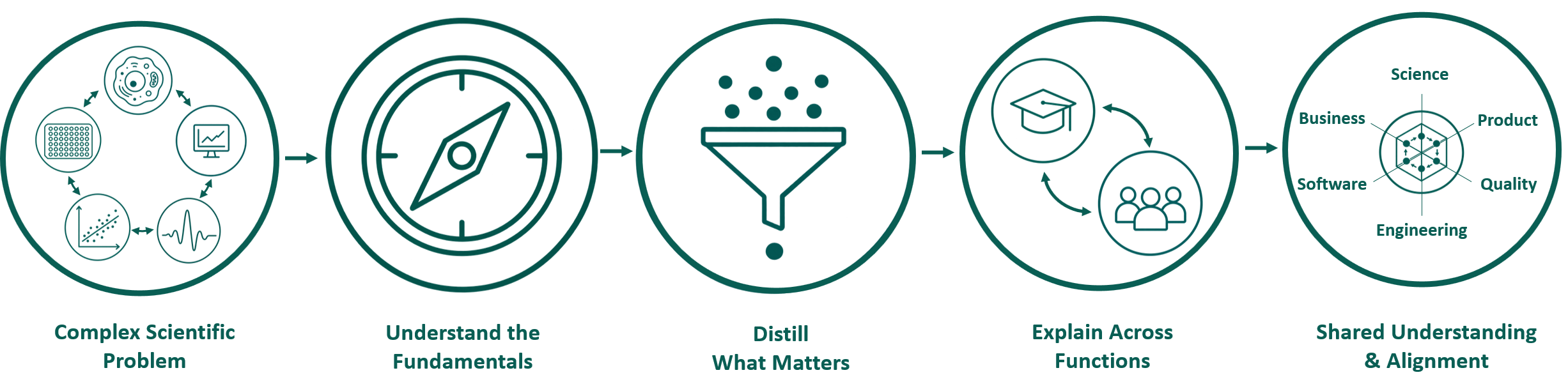
Complex scientific problems often span biology, technology, data, and multiple functions. The process shown here moves from establishing the fundamentals, to distilling the critical information, to explaining the problem in terms each audience can use—so scientists, engineers, software, quality, product, and business teams can work from a shared understanding.
Independent by design
Baseline allows me to continue doing the parts of science I value most: learning new biology and technology, working through difficult technical questions, and helping people solve problems that matter.
It is intentionally principal-led. Clients work directly with me, and the work stays focused on the scientific question rather than expanding into a larger consulting process than the problem requires.
Sometimes the answer will involve additional experiments. Sometimes it will mean revisiting an assumption, a workflow, an analysis, or an interpretation.
The purpose is to see the problem clearly enough to put the next effort in the right place.
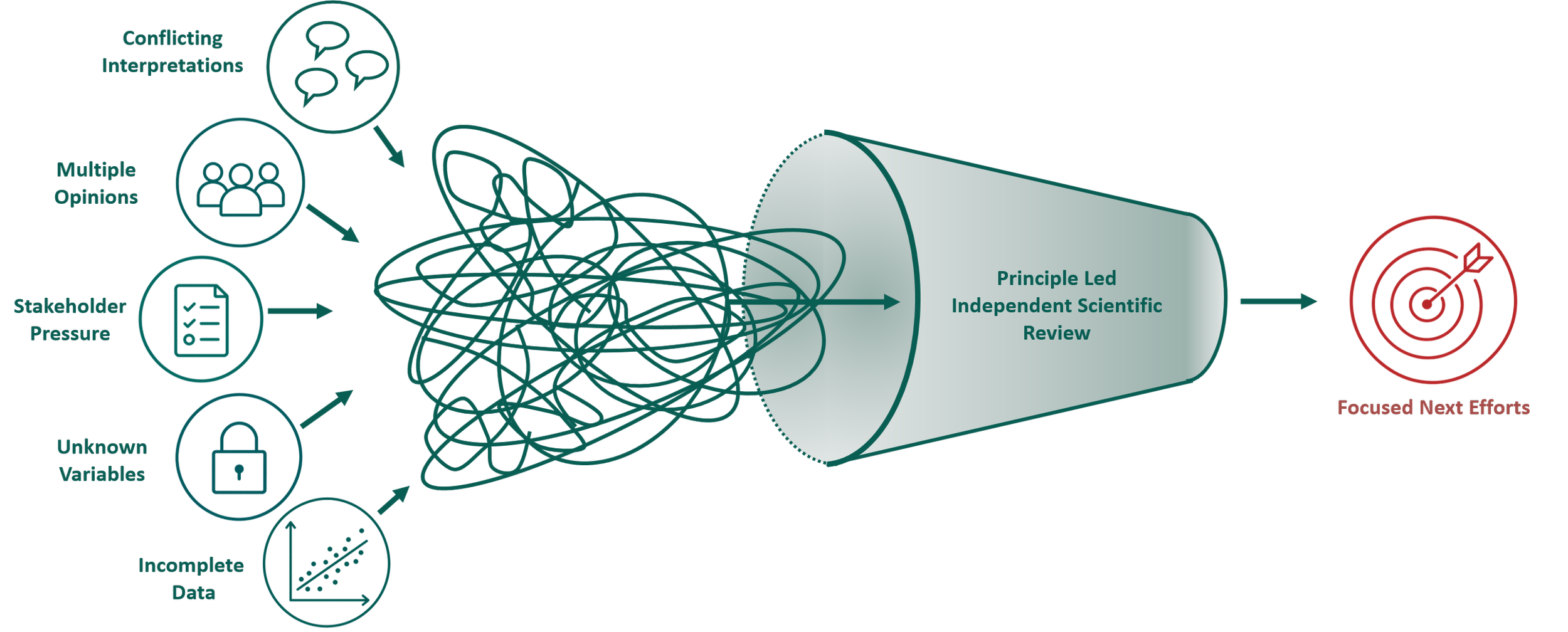
Multiple inputs can create noise and diffuse effort. Independent scientific judgment helps clarify the underlying issue and focus the next step—without expanding the work beyond what the problem requires.
Start with the Scientific Question
If a scientific or measurement problem is consuming time and resources without producing greater clarity, an independent perspective may help identify where to focus next.
Start with a discussion to determine whether Baseline can help and what level of support may be appropriate.

Please provide only a brief, non-confidential description. Do not submit proprietary, patient-identifiable, or other sensitive information through this form. Submission of this form does not establish an advisory relationship.